
WHAT WE BUILD TODAY
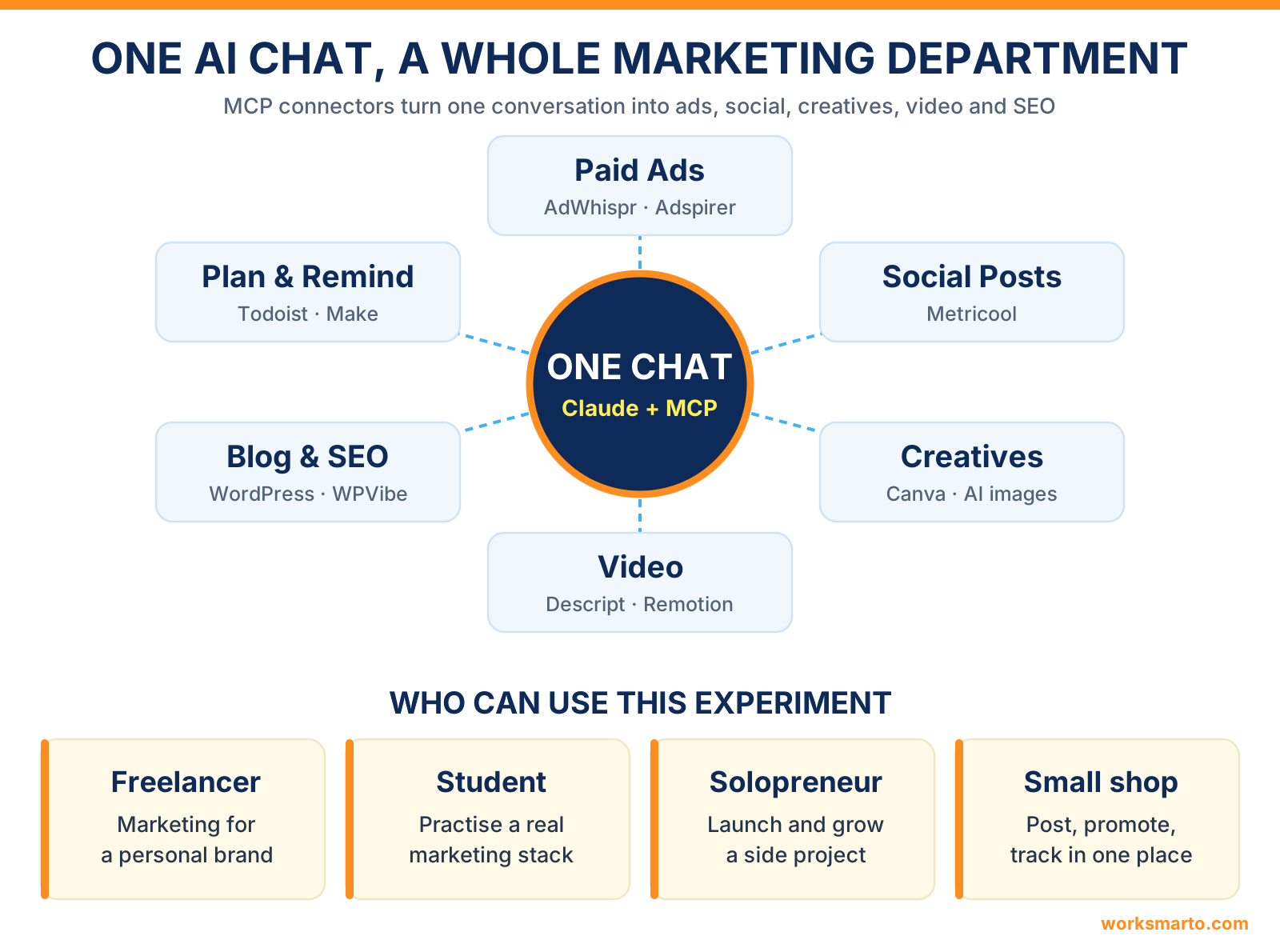
A one-chat marketing department: ads, social posts, creatives, video and SEO run from Claude through an AI marketing stack of MCP connectors.
Level: Beginner Stack: Claude · MCP connectors · Metricool · Canva · WordPress
Digital marketing used to need an agency. Then it needed a small team and fifteen browser tabs. In 2026, it needs one chat window and a clear idea.
Open Claude or ChatGPT, connect the right MCP servers, link the ad and social accounts, test them once, and the AI becomes the marketing department. The founder’s job shrinks to one word: oversee.
This guide maps the full stack, covers the organic side most people forget, flags the cost traps for anyone running several brands, and looks at where this is heading next.
THE 30-SECOND TAKE
- One AI chat with the right MCP connectors can cover ads, social, creatives, video and SEO.
- The founder’s job moves from doing marketing to overseeing it.
- Running several brands? Use one scheduler, one automation layer and pay-per-use tools.
Read it your way: scan the stack table, follow the five-step flow, copy the strategy prompt, then check the cost cards before connecting more tools.
1. What Changed: Tools Now Come to the AI
The shift comes from MCP, the Model Context Protocol. Instead of a human logging into Meta Ads Manager, Canva, a scheduler and WordPress one by one, the AI talks to each of them directly. If the term is new, start with What Is an MCP Server? (Explained in 2 Minutes).
BEFORE → AFTER
Before: 15 tabs
Log into each tool, copy, paste, repeat for every channel.
After: one chat
The AI reaches each tool through MCP and reports back in the same conversation.
The result: strategy, asset creation, publishing, ad launches and reporting happen inside the same conversation. We covered the bigger picture in MCP in 2026: The Protocol That Just Made Every Tool’s Learning Curve Irrelevant.
2. The One-Chat Marketing Stack
Here is how each marketing job maps to a connector. These are the ones the WorkSmarto setup actually uses.
The strategy layer is the AI itself: brand positioning, audience, content pillars, ad angles and the weekly plan.
Approval rule
Launch every new campaign paused. Review the ad, the audience and the budget in the chat, then switch it on yourself.
3. “Organic Is Missing” — Not Quite
Most people see AI marketing as ads plus social posts. Organic growth is actually covered too, just across a few tools.
Search itself is changing too. Ranking inside AI answers matters alongside Google rankings. Read AI Digital Marketing in 2026 — Why AEO and GEO Matter More Than SEO Alone for that side of the story.
4. The Setup in Five Steps
Step 1: Connect
Open Claude and connect the ad, social, design, video and website MCPs.
↓
Step 2: Link and test
Link each account (ad accounts, social profiles, website) and run one small test action on each.
↓
Step 3: Strategy
Ask the AI to build a brand strategy: audience, positioning, tone, content pillars and offer.
↓
Step 4: 30-day calendar
Turn it into a 30-day calendar with scheduled posts, blog topics, creatives and one paused test campaign.
↓
Step 5: Review weekly
Kill what fails, scale what works, approve the next batch.
Steps 3 and 4 start with one prompt. Fill in the brackets and paste it into the chat once the connectors are linked.
That is it. The work moves from doing to overseeing. This is the same idea behind running a website and store from one mobile chat box.
5. Running Many Brands? Watch the MCP Costs
One brand is cheap. Five brands with several accounts each can quietly turn into a pile of subscriptions. A few rules help:
One scheduler for every brand
An agency or multi-brand plan usually costs less than separate tools per brand.
Pay-per-use over per-seat
Credit-based tools like Apify or DataForSEO cost almost nothing in quiet months.
Free image models first
Use open models for drafts and volume, and paid generation only for hero creatives.
One automation layer
Stacking Zapier, Make and n8n doubles the bill. See Zapier vs Make vs n8n, built side by side.
Batch work weekly
Many MCPs have daily call limits. One planned weekly session beats dozens of scattered requests.
Check free tiers and daily caps
Check before connecting a new tool, and cut anything that duplicates another connector.
For a real breakdown of what a lean stack costs, read The WorkSmarto Stack (Real Costs + What to Cancel) and Stop Adding Tools.
6. How Marketing Moved From Big Brands to Everyone
1. The big-brand era
TV, print and large agencies. Distribution was the barrier, and only big budgets could buy attention.
2. The digital agency era
Facebook and Google ads opened reach to small businesses, but running them well still needed a team of specialists.
3. The AI agency era
One person with ChatGPT and Canva could replace that team. But it still meant copy-pasting between a dozen tools all day.
4. The agentic era (now)
One chat runs strategy, creates assets, publishes, launches ads and reports back. The tools are no longer the barrier. Taste, consistency and a real point of view are.
7. Everyone Should Have a Brand in 2026
A brand is no longer a big-company privilege. A freelancer, a student, a local shop or a weekend side project can now look and operate like a funded startup.
THE PATH
Have an idea → Build a brand around it → Blog → Social → Small ads → Learn → Repeat
We explored this solo-founder model in The One-Person AI Business.
8. What Comes Next
WorkSmarto verdict
Worth exploring when: marketing work is spread across too many tabs, or one person is running one or more small brands.
Start small: connect → test → strategy prompt → 30-day calendar → weekly review.
Do not skip: paused-first campaigns, daily call limits, duplicate tools and the weekly human review.
The Bottom Line
The marketing department of 2026 is a chat window with the right connectors. Connect, test, strategize, schedule, and oversee. The barrier is gone. The only question left is whether the idea is worth building a brand around.

[…] Ads, social posts and SEO through connectors: The One-Chat Marketing Department. […]