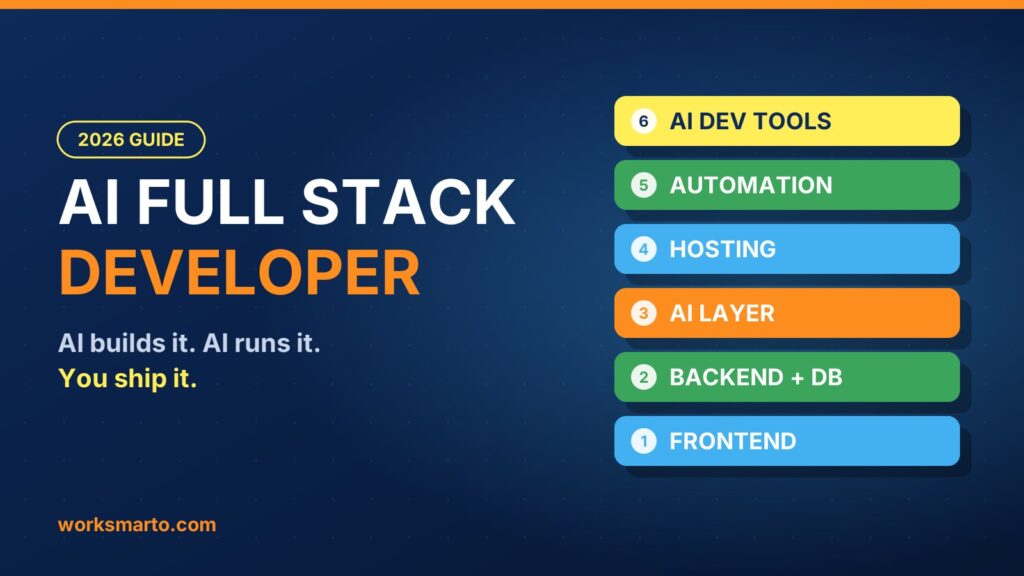
WHAT YOU’LL LEARN
What an AI full stack developer really is, the tools behind it, and the fastest way to become one: by shipping real products.
Level: Beginner Stack: React · Supabase · Groq · Vercel · Copilot · Claude
Full stack development used to mean one thing: you could build the part users see and the part they don’t. Today there’s a third layer, and it’s changing who gets to build software.
Micro web SaaS tools live on worksmarto.com. An Android app called T Wala English. Automations running quietly on cron jobs. Experiments shipped just to see if an idea works. All of it built by a single developer, with occasional freelancer help, using AI tools as the rest of the team.
That’s the AI full stack in action. Here’s what it means, and how to get there.
THE 30-SECOND TAKE
- Full stack: frontend + backend + database. One person builds the whole app.
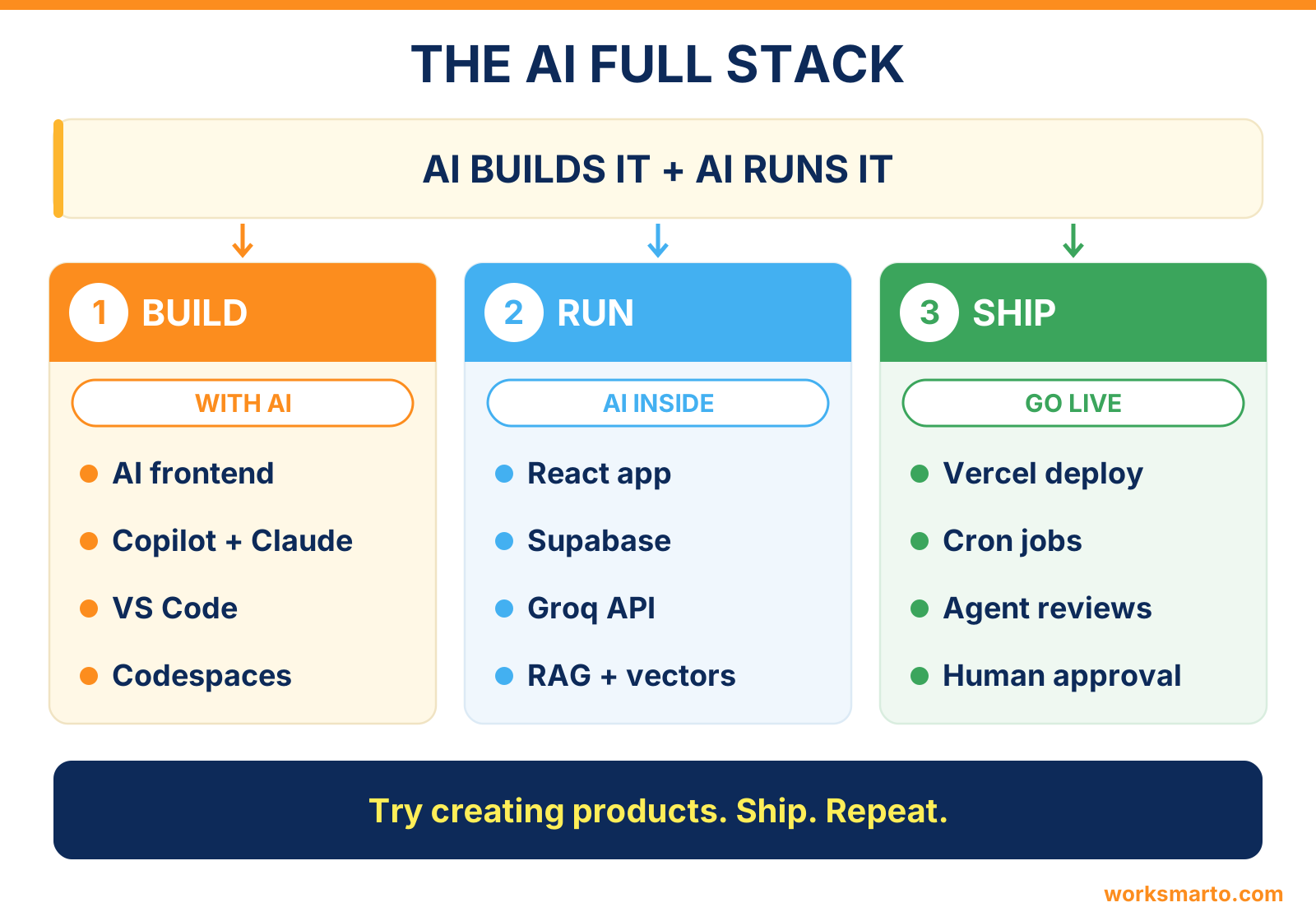
- AI full stack: AI builds the app and AI runs inside the app. The developer becomes the architect.
- How to become one: try creating products. Small, live, useful, repeated.
Read it your way: scan the layers table, learn the new terms, then follow the 8 steps.
YOUR LEARNING PATH
1. Full Stack in 30 Seconds
Every app has two sides:
Frontend · The face
Everything users see, click, scroll and tap.
Backend · The brain and the memory
The server that runs the logic, and the database that never forgets.
A full stack developer builds both. Idea in, working product out. No hand-offs, no waiting on anyone.
In short: full stack means one person can build the whole app, front to back.
2. So What Is AI Full Stack?
Same stack. Now with AI wired into every layer, doing two jobs at once.
1. AI builds the app. Describe a screen in plain English, and a frontend appears. Stuck on a bug? AI explains it, fixes it and suggests a cleaner way. Ready to launch? Deployment takes minutes, not days.
2. AI runs inside the app. The product itself thinks. It plans, writes, scores, analyzes and answers. An architecture planner that turns a rough idea into a full tech plan. An idea validator that tells founders whether their concept stands a chance. An English learning app that spins stories around each learner.
Full Stack = Frontend + Backend + Database
↓
+ AI that builds it
↓
+ AI APIs that run inside it
↓
+ Automation that keeps it running
↓
= AI Full Stack
An AI full stack developer builds products where AI powers the features and AI helps write the code. The developer stops being the one who types everything and becomes the one who decides everything: architect, reviewer and shipper.
In short: AI full stack = AI builds the product, AI powers the product, and a human steers both.
3. The AI Full Stack, Layer by Layer
A Real Example: architect.worksmarto.com
Frontend: React
Backend and database: Supabase
AI layer: Groq, for responses that feel instant
Hosting: Vercel, deployed straight from GitHub
A complete, live product on free and low-cost tiers. No server to babysit. No payroll. Just a stack that works.
Frontend Is Now Built With AI
Tools like Lovable come with AI baked in. Type what the app should do, and out comes a working React frontend, often already plugged into Supabase. Bolt and v0 play the same game.
These builders sprint through the first stretch. But the finish line is where products live or die: custom backend logic, AI integration, security, debugging and actually going live. That last mile still belongs to a real developer.
In short: six layers, mostly free tiers, and AI doing the heavy lifting at every step.
4. The Dev Setup Behind It All
No fancy office. No expensive licenses. Just a sharp, lean setup:
VS Code · Home base
Where every piece comes together.
GitHub Copilot · The pair programmer
Never takes a break. Suggests code, completes functions and catches errors mid-keystroke.
Claude · The senior engineer on call
Plans features, writes full modules, untangles nasty bugs and reviews code with fresh eyes.
GitHub Codespaces · A dev machine in the browser
Any laptop, anywhere, zero setup.
Freelancers · Occasionally
Extra hands for specialized pieces when speed beats solo.
One developer. The right AI tools. A little outside help. That’s a team.
The Role Has Changed
Before: write every line, fix every bug, ship when exhausted.
Now: direct the AI, review what it builds, fix what breaks, ship.
Less typist. More architect.
5. New Terms Every AI Full Stack Developer Should Know
AI Orchestration
The conductor of the AI orchestra. It decides which model plays which part, in what order, and how all the pieces come together into one result. One prompt, one answer is a solo. Orchestration is the full symphony.
AI Agents
AI that stops talking and starts doing. An agent plans the steps, grabs the tools it needs, checks the results and decides what’s next. Put a few together with different roles, and you’ve got a multi-agent team: one writes, one reviews, one tests.
AI APIs
The front door to a model’s brain. Groq, Gemini, OpenRouter and others let any app knock, ask a question and walk away with intelligence. Every AI feature starts with a single API call.
MCP (Model Context Protocol)
The universal adapter for AI. An open standard that plugs AI straight into real tools and data: WordPress, GitHub, Google Drive, databases. With MCP, AI stops saying “here’s how to publish that post” and simply publishes it.
Plugins
Power-ups for AI tools. Each one bundles skills, commands and connectors so the AI walks in already knowing how to handle a specific job.
LangChain
The LEGO set for AI apps. Ready-made blocks for models, prompts, memory, tools and data, so developers build products instead of rebuilding plumbing.
LangGraph
LangChain’s map-maker for agents. It lays out an AI workflow as a graph of steps, complete with loops, branches and saved progress. Complex agents stop wandering off and start following the route.
RAG (Retrieval-Augmented Generation)
An open-book exam for AI. Before answering, the app looks up the most relevant pages from your own content and hands them to the model. The result: answers built on facts, not guesswork. Perfect for website chatbots, help desks and knowledge tools.
Vector Database
A database that understands meaning, not just matching words. Content is turned into numbers called embeddings, so “cheap flights” can find “budget airfare.” It’s the engine room behind RAG. Popular picks include Pinecone, Chroma, Weaviate, and Supabase with pgvector, which keeps everything in one stack.
How It All Clicks Together
App calls an AI API
↓
RAG pulls context from a vector database
↓
Agents built with LangChain or LangGraph do the steps
↓
MCP and plugins connect real-world tools
↓
Orchestration keeps the whole band in tune
Want to go deeper? Start with What Is an MCP Server?, see agents in action in AI Agent Teams in 2026, and build a RAG-style assistant with the Gemini AI Chatbot WordPress Guide.
In short: APIs give the brain, RAG gives the facts, agents do the work, MCP connects the tools, orchestration runs the show.
6. How to Become an AI Full Stack Developer
Try creating products.
That’s the secret, and it’s not really a secret. No course or certificate turns someone into an AI full stack developer. Shipped products do.
Step 1 · Pick one small problem
Not a billion-dollar startup. One annoying task a tool could kill.
Step 2 · Set up your AI dev environment
VS Code, GitHub Copilot and Claude. Open Codespaces to start without installing a thing.
Step 3 · Build the frontend with AI
Lovable, Bolt or v0 can hand you a working UI by lunch.
Step 4 · Connect a backend
Supabase gives you data, login and APIs in one shot.
Step 5 · Add an AI feature
Plug in Groq or OpenRouter. Learn prompting the real way: by fixing bad answers.
Step 6 · Go live
Deploy on Vercel. Real users break things in ways no tutorial predicts, and that’s the best teacher there is.
Step 7 · Automate something
One cron job that runs every day. This is where backend skills level up fast.
Step 8 · Repeat
Every new product unlocks a new skill: auth, payments, mobile, agents, RAG, automation.
Five or six small products in, the full stack stops being theory and starts being muscle memory. New to building with AI? Your First AI Workflow is a 30-minute place to start.
Want a first project right now? Paste this into Claude:
In short: pick a problem, build with AI, ship it live, automate one thing, then do it again.
7. Mistakes to Avoid
Watch out for
API keys left exposed in the frontend.
Supabase tables wide open without row-level security.
AI-written code shipped without a single test.
AI writes code fast. It writes bugs fast too. Knowing what to check is what separates a builder from a prompt typist.
The next move is letting AI check AI. Multi-agent setups can assign one agent to write, another to review and another to test, all before a human looks at a single line. As of 2026, a human in the loop is still essential: someone has to judge what’s right, approve the changes and catch what the agents miss. But multi-agent AI teams are getting sharper every month at hunting down and fixing bugs on their own. Every improvement turns one developer into a bigger team.
In short: let agents write, review and test, but keep a human in charge of the final yes.
WorkSmarto verdict
Worth exploring when: you have small product ideas and want to build them end to end without a team.
Start small: one problem → Lovable or v0 frontend → Supabase → Groq → Vercel → one cron job.
Do not skip: key safety, row-level security, testing AI code, and a human review before anything goes live.
Final Thought
Tutorials teach syntax. Products teach engineering. The fastest way to become an AI full stack developer isn’t more preparation. It’s building.
Stop preparing. Start building. One small, live, useful product at a time.